
Applied language science for social-ecological change
Language Untapped
Dive into the language shaping how we understand, value and manage water.
Language Untapped brings applied ecolinguistics into water research, policy, management and communication.
It explores how water is conceptualised and represented across different communities, sectors and institutions, and how those differences shape perception, reasoning and judgement.
Tensions surrounding water management are carried, reinforced and reshaped through language. Understanding where meanings align, diverge or become obscured is an important step towards more intentional communication that clarifies complexity, builds shared understanding and lays stronger foundations for constructive collaboration.

Water carries many meanings
Water is ecological, cultural, social, economic and political.
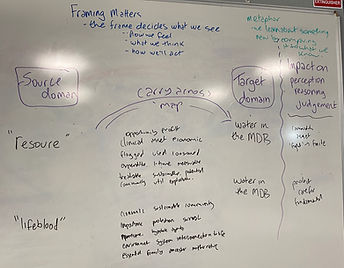
It may be understood as a resource, an asset, an entitlement, a service, a risk, a habitat, a cultural responsibility, a shared resource or part of a living system.
Each framing directs attention differently. It foregrounds particular values, relationships and responsibilities while other aspects of the system can recede from view. No single framing captures the whole.
Language Untapped examines these different ways of conceptualising water and asks what they make visible, what they obscure and how they shape the conversations that follow.
Language is part of water management
Water management is grounded in technical knowledge, evidence, regulation and practical experience. But that knowledge is interpreted, explained and negotiated through language.
Terms such as water security, scarcity, allocation, entitlement, efficiency, resilience, environmental water, cultural water, customer, community and stewardship can appear familiar and self-explanatory, but they carry implicit meaning.
Different groups may use the same word while understanding it differently. Other distinctions may remain implicit or disappear entirely as technical and policy language becomes familiar through repetition.
Recognising these differences can help identify what the communication task actually is: whether something needs to be explained more clearly, assumptions made visible, terms distinguished, competing frames understood or a stronger basis for shared language developed.
What people say
"Directly relevant to our work & understanding that if you want research to have impact you need to understand your audience & communicate it properly."
Research Scientist, OneBasin CRC

Applied ecolinguistics in water systems
Language Untapped draws on the same foundations as Language Unearthed, combining applied ecolinguistics with cognitive linguistics, discourse analysis, values research, social neuroscience and ecological systems thinking.
The inquiry can move from individual words and grammatical choices to the wider meaning systems they help create.
In water contexts, this may include examining:
-
Frames and categories: how issues such as scarcity, security, productivity, restoration or fairness are defined and bounded
-
Metaphor: the models through which water systems, risks and relationships are understood
-
Values and evaluation: what is presented as important, desirable, threatening or worth protecting
-
Agency and responsibility: who is positioned as acting, deciding, benefiting or carrying responsibility
-
Narrative and time: how past decisions, current pressures and future possibilities are connected
-
Underlying worldviews: assumptions about what water is, what it is for and what kinds of relationships with water are considered legitimate or possible.
These patterns provide an evidence base for understanding how meaning is being constructed across a water issue.
What people say
"It has given me the tools and motivation to keep going."
Melbourne Water Workshop Participant, Vic.

Where meanings converge
Complex water questions often bring together people working from different forms of knowledge, experience, responsibility and attachment.
A researcher, irrigator, Traditional Owner, water utility, environmental manager, policymaker and local community may be talking about the same river or catchment while carrying quite different understandings of what matters and why.
Language analysis can help reveal where meanings overlap, where they diverge and where apparently shared terminology may be masking quite different assumptions. This creates a stronger foundation for explaining complexity, acknowledging legitimate difference and communicating across boundaries without flattening the issue.
From insight to intentional communication
Once recurring language patterns are visible, they can be examined rather than simply repeated.
This might involve clarifying ambiguous terminology, making hidden assumptions explicit, distinguishing between competing frames, developing explanations that better represent system complexity or exploring different ways to express values, agency and responsibility.
The purpose is to communicate with greater awareness of the meanings already operating in the system, and to create better conditions for shared understanding, deliberation and constructive collaboration.

From awareness to action
Language Untapped is designed for people working where water science, policy and people meet.
It is particularly relevant to:
-
water authorities and utilities
-
catchment and natural resource management organisations
-
water research, planning and extension teams
-
river, wetland and riparian restoration
-
water and environmental policy
-
water literacy and public communication
-
drought and climate adaptation
-
cross-sector partnerships working with catchment and waterway health
Language Untapped is the water-specific application of the broader Language Unearthed approach.
Learn. Understand. Apply.
Language Untapped can be explored through a 90-minute introductory webinar, a half-day workshop, language analysis or a focused reframing session.
