
Applied language science for social-ecological change
Communication for Community Resilience and Connection
Building communication capacity for connected, resilient communities
Translating the science of connection into practical communication and capacity building tools
Connected people and communities are resilient. They are better able to cope with disruption and continue to function in positive ways.
Communities navigating change need evidence-based approaches that activate connection and collaboration, orientating people towards the opportunities in change, together.
Drawing on social neuroscience, cognitive linguistics, values theory and systems thinking, I provide training and strategic support that builds your confidence and capacity to communicate in ways that strengthen social resilience and adaptive capacity.
This work is designed to support community groups, not-for-profit organisations and networks seeking to strengthen their connection and resilience, especially in rural, regional and remote contexts.

Artwork: Anja Rozen
Build social resilience through interdisciplinary understanding
This approach to research, training and strategy applies a diverse evidence base to practical social resilience and community connection.
Social neuroscience
-
How connection and disconnection affect the stress response, decision-making and adaptive capacity.
-
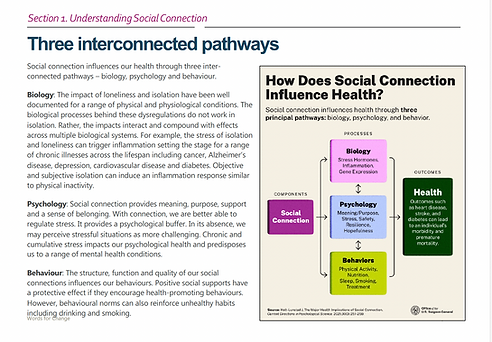
Why loneliness is biological.
-
How safety and threat shape our ability to collaborate.
Cognitive linguistics and framing
-
How the metaphors and frames we use unconsciously shape reasoning.
-
Why "bouncing back" creates different expectations than "bouncing forward".
-
How language encodes worldviews.
Applied values theory
-
Explore a practical framework for understanding how values operate as a system of complementary and competing motivations.
-
Learn how to activate the values that orientate people towards the opportunities in change, together.
Systems thinking
-
How connection emerges from interactions between people, place, participation and purpose.
-
Why community resilience is more than the sum of its parts and can't be reduced to individual factors.
Case study: Connection Needs Analysis
The Rural City of Wangaratta's Grit & Resilience Consortium commissioned a Connection Needs Analysis to understand what was needed to create a culture of connection and inclusion.
The analysis synthesised publicly available data, extended conversations with 15 community connectors and peer-reviewed research spanning social neuroscience, connection science, mental health and community resilience.
The report revealed how biological stress responses, social stigma and intersectional barriers shape disconnection. It showed why some people face higher risks than others. It explained how connection emerges from interactions between people, place, participation and purpose.
Three key themes emerged:
-
First, the need for greater awareness and understanding of connection science to reduce stigma and increase compassion.
-
Second, the importance of building safety, skills and confidence as foundations for seeking and fostering connections.
-
Third, the value of intentional design that accounts for diverse needs within diverse communities.
Recommendations were presented aligned with the Consortium's program blueprint, giving them practical next steps grounded in both community experience and interdisciplinary research.


Case study: Building a Culture of Generosity - Language Strategy for Regional Community Resilience (de-identified Community Foundation)
A well-established regional community foundation engaged Words for Change to develop a comprehensive language-driven behaviour change strategy. With a track record of distributing over $3 million to local projects, the foundation sought to strengthen its messaging, deepen audience engagement, and build a sustainable culture of generosity and social resilience across its region.
The foundation faced several strategic communication challenges:
-
Audience Engagement: How to authentically connect with three distinct audiences (donors, grantees and the broader community) with messages that resonate and inspire action
-
Values Activation: Articulating and communicating their core values in ways that would activate pro-social behaviours like donating, volunteering, and community participation
-
Place-Based Identity: Strengthening their positioning as a trusted catalyst for locally driven, positive change
-
Behaviour Change: Moving beyond awareness to create tangible shifts in community attitudes and behaviours around giving, connection and collective action.
The Language Strategy prepared for the Foundation emphasised connection as an essential element for community resilience:
-
Connecting donors with grassroots changemakers
-
Connecting individual generosity with collective impact
-
Connecting values with action
-
Building a connected community where people experience belonging.
The messaging framework positioned generosity as essential to community resilience:
-
Creating capacity to respond to disruption
-
Building social capital through reciprocity and care
-
Fostering self-determination and collective efficacy
-
Normalising a culture where "people like us do things like this"
From scarcity to possibility
Rather than problem-focused messaging that triggers stress responses, this approach emphasises:
-
Hope and agency
-
Creativity and innovation
-
Shared purpose
-
Tangible pathways forward
Key takeaway
Effective communication is about activating the right values, telling the right story and creating the conditions for people to see themselves as part of the solution.
This comprehensive language strategy gave the foundation the frameworks, messages and confidence to inspire a culture of generosity, strengthen community connections and position themselves as a trusted catalyst for positive, place-based change.
What people say
"I wanted to let you know how much I value the brand language assets you have developed. I reference it almost daily and I hope you have seen your work reflected time and time again in our social posts, newsletters, brochure-ware, website and more. It really is a wonderful asset to have and while it is a very slow burn, we are building profile and generating momentum and I believe our messages are resonating with our donors and our community.
Communications Manager, Community Foundation
Dig deeper with linguistic tools to gain clear insights into sentiment and meaning
Language analysis reveals patterns in framing, meaning and motivation that often escape conscious awareness. These patterns shape how people think, feel and act. Understanding them helps you direct the impact of your communication.
Using computerised linguistic tools and conceptual frameworks, we examine sentiment, categorisation, cognitive processing and shifts in spatial, social or temporal focus. These insights show how people make sense of key issues and where your language can connect and clarify more effectively.
By combining statistical analysis with linguistic techniques, we build a strong evidence base to inform policy communication, stakeholder engagement and strategic messaging.
If you want to go beyond assumptions and understand how your language is really working, this is the place to begin.


Why work with Words for Change?
-
Researcher, educator and communication practitioner with expertise in social neuroscience, cognitive linguistics and systems thinking.
-
30+ years translating complex interdisciplinary research into practical frameworks that work in real-world contexts.
-
Trusted to build capacity in rural and regional communities, research teams, government agencies and purpose-driven organisations.
